
Mass Timber House Pilot Project
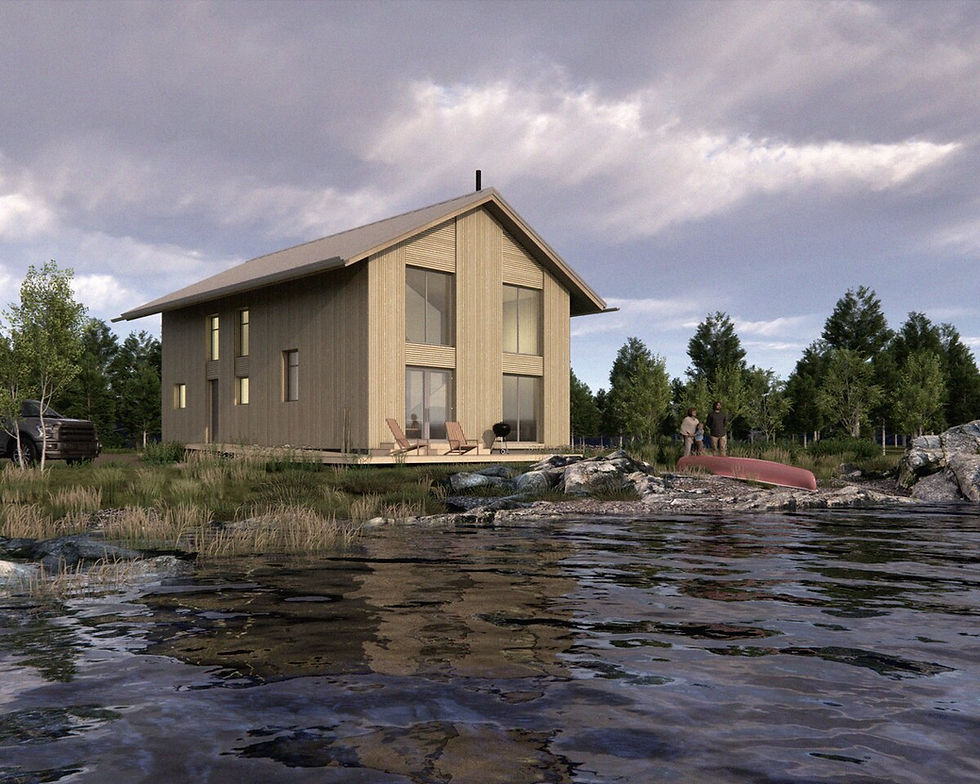
A House Built from the Land It Stands On
For years, logging trucks rolled out of Nak'azdli Whut'en territory carrying timber that would be processed somewhere else, by someone else. The community watched it happen. The question was always the same: what if that wood stayed home?
The Mass Timber House Pilot Project is one answer to that question. NCL was there to help build it.
The Project
The pilot grew out of a partnership between Nak'azdli Development Corporation and Deadwood Innovations, a Fort St. James forestry startup. Together with researchers at UNBC's Wood Innovation Research Lab and project architect Neil Prakash of Prakash Architecture, they developed something that hadn't been done at this scale in rural northern B.C.: a prefabricated mass timber housing system built specifically for Indigenous and remote communities.
The idea was to source timber from Nak'azdli forest licences, mill it locally into nail-laminated timber panels, and fabricate complete wall, floor and roof assemblies in a controlled factory setting. Ship the panels to site. Erect a home in days. Quality controlled, repeatable, built by local hands.
In practice, it was a first of its kind. The completed show home is a two-storey, 1,450 square foot residence with three bedrooms, two bathrooms, a loft and an open-concept kitchen and living room.
NCL's Role
NCL was awarded the prime contract for the pilot build, with a contract value of $650,000 covering nearly every phase from the ground up. As prime contractor, NCL coordinated subcontractors across crane, heating and site services to keep the build on track.
The work began underground. NCL built a four-foot frost wall with a slab on grade using their own heavy equipment and operators, and installed the deep services during that same phase.

With the foundation set, the crew moved to the T'Loh Forest Products finger joint mill in Fort St. James, a facility that had sat dormant for years before Deadwood Innovations began using it to upgrade local lumber. This is where NCL assembled the panels. Each one left the shop with vapour barrier, rock wool insulation and strapping already integrated, factory-ready to accept siding once on site.
Moving the Panels
The largest panels measured 40 feet by 9.5 feet. NCL partnered with Gold Hook Crane Services out of Vanderhoof to work out the crating and lifting techniques needed to get them loaded, transported and placed without damage. The T'Loh facility and the build site were only a few kilometres apart, which helped, but it didn't make the panels any lighter.
Once on site, a crane placed each panel into position and the crew anchored them in sequence. What would have taken months to frame and enclose on a conventional build was standing in days.

Solving the Hard Parts
No pilot project goes exactly as drawn.
The electrical rough-in was the most demanding phase. During panel fabrication, trenches had been cut into the mass timber structure to route electrical wiring. On site, some pull strings had been pinched during assembly and couldn't be used. Some trenches didn't align as planned. NCL's crew re-routed portions of the wiring through the insulated space on the exterior of the panels and kept the job moving.
Heating required a specialized approach. With no crawl space or traditional floor joist cavities for ductwork, a standard forced-air setup wasn't an option. QT Services from Prince George designed and installed a high-velocity system with smaller ducts sized to fit the available spaces.
Plumbing was straightforward. NCL handled both rough-in and finishes without complications or extra steps from the structure type.

What It Means
The Timber House is currently serving as a show home for Nak'azdli Development Corporation, with plans to hand it over to a Nak'azdli family or elder after the demonstration period. But the ambition behind it reaches further than a single house.
The panel system is designed to be repeatable. Panels can be fabricated through the winter months and erected on site in the summer, potentially allowing a local crew to deliver ten or more homes in a season. The system can also travel — panels shipped and assembled by other First Nations communities who want the same model for themselves.
For NCL, this project is evidence of what local capacity looks like when it's given something genuinely new to build. The crew had never constructed a prefabricated mass timber home before. Now they have, and the system they helped prove is ready to do it again.
Ready to Build?
NCL takes on projects of all sizes across the region. Get in touch and we'll put together a quote.
Press
B.C. North First Nation in B.C. develops prefabricated housing system from locally-sourced wood Indigenous-led business teams up with academic researchers to develop mass timber housing system Hanna Petersen · CBC News · January 2, 2026 https://www.cbc.ca/news/canada/british-columbia/fort-st-james-timber-house-9.7015537
Indigenous development company looks to carve niche in mass-timber housing construction in rural B.C. The Nak'azdli Development Corp. is putting the finishing touches on its mass-timber, prefabricated Timber House in Fort St. James at the same time that type of construction has come into vogue as a solution to Canada's housing crisis. Derrick Penner ·
Vancouver Sun · January 2, 2026 https://vancouversun.com/business/indigenous-development-company-looks-to-carve-niche-in-mass-timber-housing-construction-in-rural-b-c
B.C. First Nation Tackles Rural Housing Crunch with Prefab Design, Locally-Sourced Wood Rosemary Cairns · The Energy Mix · January 7, 2026 https://www.theenergymix.com/b-c-first-nation-tackles-rural-housing-crunch-with-prefab-design-locally-sourced-wood/

